Wednesday, June 19, 2013

Fort Mifflin

Posted by Stu On May - 13 - 2010

Tags: , , , , , , , , ,

mifflin41

Fort Mifflin is a unique and, sadly, little known point of interest in Philadelphia.  It’s right on the Delaware River; it’s actually next to the Philly Airport.  It is a bit of a pain to find, though.  You’re definitely going to want to look this one up first.  There is also a small admission fee; well worth it though.

mifflin42

mifflin
The fort’s former hospital, now the ticket & info office.

mifflin2
Outside the fort’s wall.  Notice the plane coming in.

mifflin3

mifflin53
All around the fort’s perimeter is very swampy, hence the area’s name of Mud Island.

mifflin4

The fort was built in 1771 and was used by the military up until 1952.  It served some purpose for every war within that time span.  Although there are several, the two big reasons this fort is so famous come from the Revolutionary and Civil Wars.
During the Revolution, the British invaded and ultimately captured the city of Philadelphia in 1777.  General Washington used Fort Mifflin as a distraction and ordered it manned until the very last possible moment of escape.  He knew he was outnumbered and under-supplied; fighting full force in Philly would have been suicide.  For five weeks, the British pounded Mifflin, with many of its buildings being reduced to rubble.  The fort’s official website states “It is the site of the largest bombardment the North American continent has ever witnessed.”  Holding Mifflin allowed Washington’s army to escape and flee to Valley Forge; it’s almost certain that if the fort fell sooner, the Revolution would have been much shorter with very different results.
During the Civil War, the fortress was used as a prison for captured Confederates, so it’s no surprise there are ghost stories surrounding the place.  The most famous involves the hanging of William Howe, a Union deserter convicted of murder.  He was held in what is known as Casemate #11.  His signature can still be seen on the wall inside.  He’s said to still haunt the fort, especially the casemate.  When I went, there were actually 2 ghost hunters trying to record voices inside the casemate.
There are, of course, many other supposed ghosts haunting the place.

mifflin5
Finally heading through the gate…

mifflin7

mifflin8

mifflin14
Officers’ Quarters & Soldiers’ Barracks

mifflin10
Quartermaster’s store.  Now a gift shop.  Closed when I went.  I really wanted a magnet :/

mifflin12

mifflin15

mifflin13
Commandant’s House.  The inside was being restored during my visit…

mifflin39

mifflin40
Guessing that’s what the place’ll look like after renovation…

Some more outside shots before heading underground to infamous Casemate 11…

mifflin25

mifflin26

mifflin27

mifflin28

mifflin23

mifflin33

mifflin22

mifflin16
Entrance to Casemate 11

mifflin17

mifflin18

mifflin19
Some of Howe’s writing.

mifflin20

mifflin21
End of the casemate.  Imagine this as your prison cell.

Lots of places on the grounds where you can go underground…

mifflin29

mifflin30

mifflin31

Like I mentioned earlier, the fort served as a prison during the Civil War.  Mister Howe may have gotten special treatment and had his own casemate, but that wasn’t the case for the Confederate prisoners.  6 casemates were used as prison cells.

mifflin43

mifflin45

mifflin46

mifflin48

mifflin49

mifflin50

The barracks and officers’ buildings serve as a museum, with artifacts, models, and even a small display of photos of TV’s Ghosthunters when they came to visit the fort.

mifflin32

mifflin38

mifflin37

mifflin35

mifflin34
Ghosthunters stuff

mifflin51

mifflin52

mifflin55

For admission, hours, directions, and all that jazz, check out Fort Mifflin’s official site.

Popularity: 21% [?]

Sugarloaf Massacre Monument & Grave

Posted by Stu On January - 27 - 2009

Tags: , , , , ,

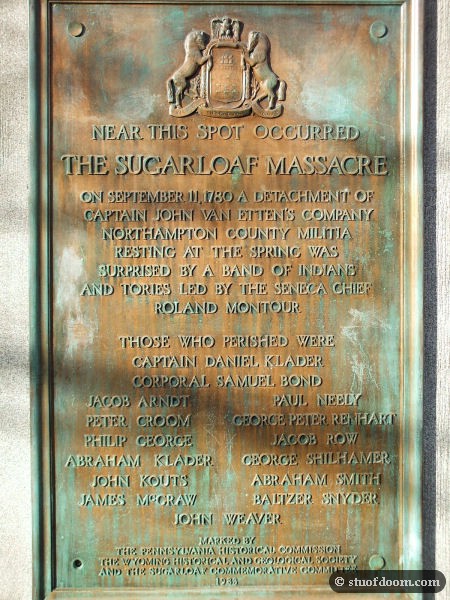
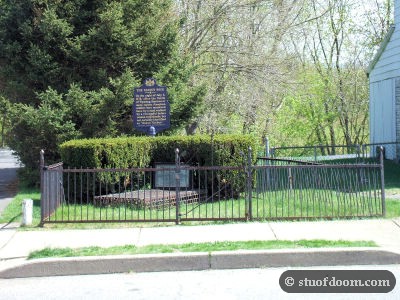
Found along Walnut Avenue in Conyngham is a small, seemingly overlooked Revolution-era monument. Near this site on September 11, 1780, Captain Daniel Klader and his men were ambushed and slaughtered by a group of Tories and Seneca. Chief Roland Montour was also among the mob.
That Montour name sound familiar? It should. Just 2 years earlier, his sister-in-law started a massacre of her own.

So the monument itself is pretty boring, you probably think. I, to an extent, agree. Good thing there’s more.

There is a very small trail behind the marker leading into the woods. The trail goes perilously close to a house and I was initially hesitant to follow it. Good thing I did, because at its end is Danny.

The rest of his men are supposed to be buried nearby. This was the only stone I saw though.

Popularity: 17% [?]

Queen Esther’s Rock

Posted by Stu On June - 27 - 2008

Tags: , , ,

Interesting bit of Revolution history here that I never saw in any text book. And, just like the Matlack Grave, it’s wedged in between 2 houses. Too bad there’s grating over the rock; from what I hear, it’s there to stop people from chipping away at it.

On July 3, 1778, just after the Battle of Wyoming, Queen Esther Montour reportedly smashed the heads of about a dozen US soldiers on this rock. “Queen” Esther was most likely not a queen; Native Americans generally didn’t have such a hierarchy. Chances are good Esther was not full-blooded Indian anyway; it’s suggested she was half.

Popularity: 10% [?]

Toms River Blockhouse

Posted by Stu On January - 21 - 2006

Tags: , , , ,

Don’t know why I didn’t put this up sooner; I took these pictures last year.

Just about anyone who passes through downtown Toms River has seen the small waterfront Huddy Park, with a few gazebos, a bridge, and…..a fort? There is a replica blockhouse, or small fort, of the original one that stood on the hill that is now Robbins Street. It’s not very large or complex – just 4 walls made of wood posts, spiked at the end. A few wooden cannons sit at the corners.
Not too many people are aware a battle took place here in 1782. Captain Joshua Huddy, high on the British and Loyalists’ hit list, was in charge of the fort. A group of about 80 British troops and Tories attacked the small village of Toms River; Huddy’s handful of men had no chance. The blockhouse and all of the town, save a house or 2, were burned to the ground. Huddy was taken to New York to be tried. He was found guilty of murdering a British officer even though they were well aware he didn’t commit the murder. He was hanged in Monmouth County’s Highlands shortly afterward.

Popularity: 10% [?]

Greenwich Tea Party Monument

Posted by Stu On September - 21 - 2005

Tags: , , ,

Most Americans know what the Boston Tea Party was, but not many are aware the act was not unique to Boston. Nope, there were a couple of “tea parties”, one happening in southern NJ.

In 1774, a year after the defiance in Boston, a tea party happened along the Cohansey River in Greenwich. A British ship that was denied entry into Philadelphia tried to sell its cargo of tea in Greenwich. Worried about patriots, the British sought the help of a Tory in town. He agreed to let them store the tea in his cellar. Well, the patriots found out about this secret deal and decided to reenact the events that occurred in Boston. Dressed at Indians, they broke into the basement, stole all the tea, piled it in a nearby field, and burned it.
The tea burners were sued twice, once by the East India Tea Company, and once by the man who was storing the tea. Little did the Brits realize 2 of the tea burners were brothers of the town sheriff, who just so happened to select the jury, and who just so happened to make his nephew the jury foreman.
Nobody was found guilty.
The second trial was state appointed. Luckily for our band of burners, most of the jury was patriots, so they got off yet again.

Popularity: 11% [?]

Federal Hill

Posted by Stu On September - 21 - 2005

Tags: , , ,

*Note* This is not yet a complete trip. We could not find the fabled “Iron Door.”

Federal Hill was a lookout for Continental soldiers during the Revolution as well as the site of a mutiny. The leaders of the mutiny were eventually forced to be executed by fellow soldiers – an order given by General Washington himself.
But that’s not what makes this place well known among curiosity seekers. The hill was a Bund camp during the WWII years and has many stories of Nazis attached to it. The most famous part of the hill is the Iron Door, which is supposed to lead to several things, including a room full of Nazi memoribilia. I’ve been told the door is now sealed shut.

As noted above, we didn’t find the Door. I got within 180 feet of it, and no matter which way I approached from, I ended up with a cliff in front of me. I guess you have to get to it from the bottom of the hill; we were at the top. Although we didn’t get to the Door, I did find some other interesting ruins.


Know what I think these are? Toilets. Seriously.

I hope to get back to the hill sometime soon; it’s supposed to be slated for development. If that happens, I’m sure the Door will be taken down.

Popularity: 11% [?]

Newest/Updated Places

Lausanne

Posted by Stu
May-8-2013 I ADD COMMENTS

Mighty Joe

Posted by Stu
Sep-26-2012 I ADD COMMENTS

Mars Bluff Bomb Crater

Posted by Stu
Jun-28-2012 I ADD COMMENTS

Abandoned Family Inn

Posted by Stu
Jun-28-2012 I 1 COMMENT